


Problem Statement
A vertex cactus is a connected undirected graph such that each vertex belongs to at most one simple cycle. A simple cycle is a cycle that doesn't pass through any vertex more than once. For example, the graph pictured below is a vertex cactus:
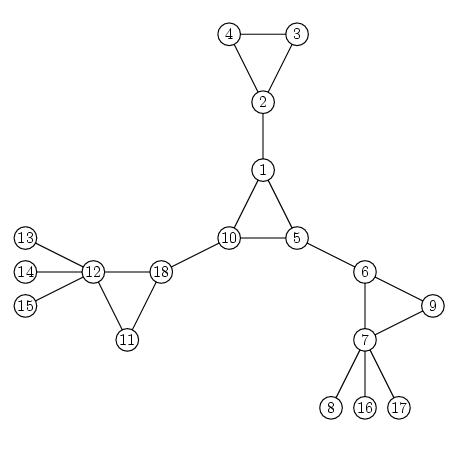
You are given an int n, the number of vertices in a graph G. The vertices are numbered from 1 to n. The edges in G are given in the String[] edges. Concatenate the elements of edges to get a comma-separated list of integer pairs. The integers in each pair are separated by a space. The pair "i j" (quotes for clarity) means that there is an edge between vertices i and j. Return the number of connected components of G that are vertex cacti.
Definition
- Class:
- CactusCount
- Method:
- countCacti
- Parameters:
- int, String[]
- Returns:
- int
- Method signature:
- int countCacti(int n, String[] edges)
- (be sure your method is public)
Notes
- A connected component of a graph G is a set of vertices such that each pair of vertices in the set is connected by a path, and no vertex outside the set is connected to any vertex within the set.
Constraints
- n will be between 1 and 200, inclusive.
- edges will contain between 0 and 50 elements, inclusive.
- Each element of edges will contain between 1 and 50 characters, inclusive.
- When concatenated, edges will contain a comma separated list of integer pairs.
- The integers within each pair will be separated by a space.
- The integers within each pair will be distinct.
- Each integer will be between 1 and n, inclusive, with no leading zeroes.
- Every pair of vertices will be connected by at most one edge.
Examples
3
{"1 2,1 3,2 3"}Returns: 1
One cycle is a vertex cactus.10
{}Returns: 10
Here each vertex is a component by itself. A graph with one vertex is a vertex cactus.5
{"1 2,3 4,4 5"}Returns: 2
Both components are trees. A tree is a vertex cactus.17
{"1 2,2 3,3 4,4 5,5 3,1 3,6 7,7 8,6 8,8 9,9 1",
 "0,10 11,11 9,12 13,14 15,15 16,16 17,14 17,14 16"}
Returns: 2
Here are two cacti and two non-cacti. The component with vertices 1, 2, 3, 4 and 5 is not a vertex cactus because vertex 3 belongs to two cycles: 1-2-3 and 3-4-5. The component with vertices 14, 15, 16 and 17 is not a vertex cactus either. Vertex 14, for example, belongs to more than one cycle.
 Back to all problems