



Problem Statement
f is a function from integers to integers. In other words, f is defined over integers, and f(x) is an integer for all integers x. You are given an integer C. f is called C-beautiful if the following equality is satisfied for all integers x:

Return the minimal possible value of the following formula when f is C-beautiful:
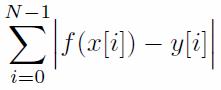
Use the following recursive definitions to generate the sequences x and y:
Return the minimal possible value of the following formula when f is C-beautiful:
Use the following recursive definitions to generate the sequences x and y:
- x[0] = xzero
- For all integer i between 1 and N-1, inclusive, x[i] = (x[i-1] * xprod + xadd) % xmod
- y[0] = yzero
- For all integer i between 1 and N-1, inclusive, y[i] = (y[i-1] * yprod + yadd) % ymod
Definition
- Class:
- FunctionalEquation
- Method:
- minAbsSum
- Parameters:
- int, int, int, int, int, int, int, int, int, int
- Returns:
- long
- Method signature:
- long minAbsSum(int C, int N, int xzero, int xprod, int xadd, int xmod, int yzero, int yprod, int yadd, int ymod)
- (be sure your method is public)
Notes
- 64-bit integers should be used to generate the sequences x and y to avoid overflow.
Constraints
- C will be between 1 and 16, inclusive.
- N will be between 1 and 10,000, inclusive.
- xmod and ymod will each be between 1 and 1,000,000,000, inclusive.
- xzero, xprod and xadd will each be between 0 and xmod - 1, inclusive.
- yzero, yprod and yadd will each be between 0 and ymod - 1, inclusive.
Examples
3
10
0
1
1
456
1
1
1
456
Returns: 0
f(x) = x + 1 is a 3-beautiful function. Since x = {0, 1, 2, 3, 4, 5, 6, 7, 8, 9} and y = {1, 2, 3, 4, 5, 6, 7, 8, 9, 10}, the sum of |f(x[i]) - y[i]| is 0.4
10
0
1
1
456
1
1
1
456
Returns: 5
x and y are the same as in example 0, but f(x) = x + 1 is not a 4-beautiful function.16
10000
654816386
163457813
165911619
987654321
817645381
871564816
614735118
876543210
Returns: 3150803357206
 Back to all problems