



Problem Statement
Paco collects penguins. His penguins like to play and run around on the ice where he lives. In order to keep his penguins safe he decided to construct a single fence enclosure to keep danger out.
Paco's penguins have fallen asleep. Acting quickly Paco placed numPosts posts in a circular configuration on the ice. Each post is placed radius meters from location (0,0). The posts are equally spaced with the first post being placed at location (radius, 0).
To construct the fencing, Paco will connect some pairs of fence posts using straight fences. No two segments of the fence are allowed to cross. In the resulting fencing, each fence post will either be unused, or it will be connected to exactly two other fence posts. In order to minimize the damage his penguins cause to the ice, he would like to minimize the area enclosed by the fence.
In order to keep all his penguins happy Paco would like to have all his penguins in the one single enclosure. Two penguins are in the same enclosure if it is possible to walk from one penguin to the other without crossing a fence.
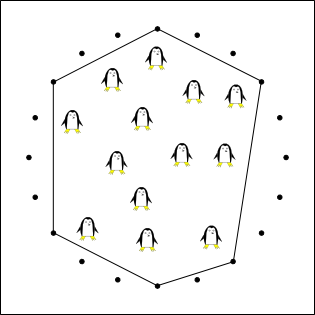
You are given two ints numPosts and radius. You are also given two int[]s x and y representing the (x,y) location of each of the sleeping penguins. Each penguin is small enough to be considered a point. Compute an return the smallest area of an enclosure that can contain all the penguins. If it is not possible to enclose all the penguins return -1.
Definition
- Class:
- FencingPenguinsEasy
- Method:
- calculateMinArea
- Parameters:
- int, int, int[], int[]
- Returns:
- double
- Method signature:
- double calculateMinArea(int numPosts, int radius, int[] x, int[] y)
- (be sure your method is public)
Constraints
- numPosts will be between 3 and 222, inclusive.
- radius will be between 5 and 100,000, inclusive.
- x will contain between 1 and 50 elements, inclusive.
- y will contain the same number of elements as x.
- Each element in x will be between -100,000 and 100,000, inclusive.
- Each element in y will be between -100,000 and 100,000, inclusive.
- No penguin will come within 10^-6 of any potential fencing.
- No two penguins will occupy the same location.
Examples
3
5
{-1}{0}Returns: 32.47595264191645
There is only one possible enclosure that uses all three fence posts.30
5
{6}{0}Returns: -1.0
4
5
{2}{1}Returns: 25.0
If the posts are numbered starting from 0 at (radius, 0) and increasing in the counter-clockwise direction. The resulting possible answers would be: (0,1,2) (0,1,3) Both enclosures cover the same area.4
5
{2,-2}{1,-1}Returns: 50.0
8
5
{8}{8}Returns: -1.0
It is not possible to enclose this penguin. Please note that while a penguin can't be located close to a potential fencing (see constraints), it can be located close to or exactly on a straight line passing through any pair of fence posts.7
10
{9}{1}Returns: 29.436752637711805
30
800
{8,2,100,120,52,67,19,-36}{-19,12,88,-22,53,66,-140,99}Returns: 384778.74757953023
 Back to all problems