



Problem Statement
Fox Ciel likes to jump around in large fields. She is currently at point (0, 0) of a field, and she wants to land at point (Tx, Ty) using exactly R jumps.
In one jump, she can move 0, 1, 2, ..., Mx units in the positive x direction and 0, 1, 2, ..., My units in the positive y direction. All jumps must have a non-zero distance. In addition, there are some jumps which she is not good at. These jumps are described in the int[] bad. If bad contains the number b, it means she cannot make a diagonal jump where she moves exactly b units in the positive x direction and b units in the positive y direction. Each element of bad will be a multiple of 10.
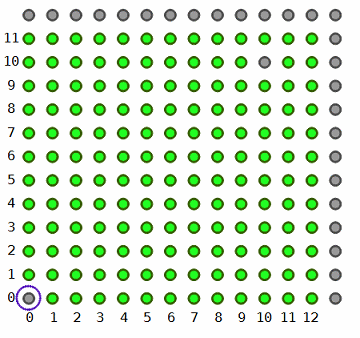
For instance, if Mx=12, My=11, bad={10} and she is at point (0, 0), then the only points she can jump to are the green ones shown below:
Return the number of ways she can start at (0, 0), jump exactly R times, and land at (Tx, Ty), modulo 10,007. Two ways are considered to be different if there is an index i, 0 <= i < R, such that Ciel lands at different points after the i-th (0-based) jump in these ways.
In one jump, she can move 0, 1, 2, ..., Mx units in the positive x direction and 0, 1, 2, ..., My units in the positive y direction. All jumps must have a non-zero distance. In addition, there are some jumps which she is not good at. These jumps are described in the int[] bad. If bad contains the number b, it means she cannot make a diagonal jump where she moves exactly b units in the positive x direction and b units in the positive y direction. Each element of bad will be a multiple of 10.
For instance, if Mx=12, My=11, bad={10} and she is at point (0, 0), then the only points she can jump to are the green ones shown below:
Return the number of ways she can start at (0, 0), jump exactly R times, and land at (Tx, Ty), modulo 10,007. Two ways are considered to be different if there is an index i, 0 <= i < R, such that Ciel lands at different points after the i-th (0-based) jump in these ways.
Definition
- Class:
- FoxJumping
- Method:
- getCount
- Parameters:
- int, int, int, int, int, int[]
- Returns:
- int
- Method signature:
- int getCount(int Tx, int Ty, int Mx, int My, int R, int[] bad)
- (be sure your method is public)
Constraints
- Tx and Ty will each be between 1 and 800, inclusive.
- Mx and My will each be between 1 and 800, inclusive.
- R will be between 1 and 1,600, inclusive.
- bad will contain between 0 and 50 elements, inclusive.
- Each element of bad will be between 1 and min(Mx, My), inclusive, and be a multiple of 10.
- All elements of bad will be distinct.
Examples
2
2
1
1
2
{}Returns: 1
There is only 1 way to reach the destination.2
2
1
1
3
{}Returns: 6
The following are the 6 ways she can reach her destination. Note that when she jumps, she must move a distance of at least one unit.10
10
10
10
1
{}Returns: 1
She can jump only once, so there is 1 way to reach the destination.10
10
10
10
1
{10}Returns: 0
This case is almost the same as the previous one. However, in this case, the required jump is a bad jump, so she cannot reach the destination in a single jump.11
11
11
11
2
{10}Returns: 140
123
456
70
80
90
{30, 40, 20, 10, 50}Returns: 6723
 Back to all problems