


Problem Statement
The 0-th and 1-st Frabonacci trees are each single nodes. For all i > 1, the i-th Frabonacci tree is constructed as follows:
- Create a new node r. This will be the root node of the i-th Frabonacci tree.
- Construct the (i-1)-th and (i-2)-th Frabonacci trees.
- Attach the (i-2)-th Frabonacci tree as the left subtree of r.
- Attach the (i-1)-th Frabonacci tree as the right subtree of r.
To traverse a Frabonacci tree in preorder, perform the following operations:
- Visit the root.
- Traverse the left subtree.
- Traverse the right subtree.
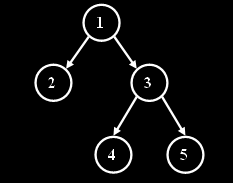
You are given three ints n, startIndex, finishIndex. Return the shortest route between the vertices startIndex and finishIndex in form of a String in the n-th Frabonacci tree. Each character of the result will be "L", "R" or "U", where "L" means a move to the left son, "R" means the move to the right son, and "U" means the move to the parent.
Definition
- Class:
- FrabonacciTree
- Method:
- shortestPath
- Parameters:
- int, int, int
- Returns:
- String
- Method signature:
- String shortestPath(int n, int startIndex, int finishIndex)
- (be sure your method is public)
Constraints
- n will be between 0 and 50, inclusive.
- startIndex will be between 1 and 1000000000, inclusive.
- finishIndex will be between 1 and 1000000000, inclusive.
- startIndex, finishIndex less or equal than the number of vertices in the n-th Frabonacci tree.
Examples
3
2
4
Returns: "URL"
3
4
2
Returns: "UUL"
3
5
4
Returns: "UL"
12
10
10
Returns: ""
 Back to all problems