



Problem Statement
You are given a convex polygon and you must count the number of N-cool points. A point is N-cool if it is a lattice point covered by the polygon and also an endpoint of some N-cool segment. A line segment is N-cool if it contains at least N lattice points that are covered by the polygon. A point is considered covered by the polygon if it is inside or on the boundary of the polygon. Endpoints of a segment are considered to be inside of it. A lattice point is a point with integer coordinates.
Consider the example in the picture below. Here N is equal to 6, and there are 21 6-cool points, marked green. Also two 6-cool segments, which are colored red, are shown.
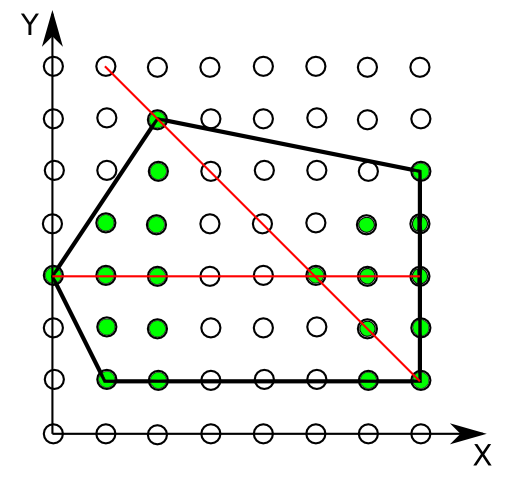
You are given int[]s x and y describing the vertices of the polygon (in no particular order). The coordinates of each vertex are specified by corresponding elements of x and y. Return the number of N-cool points.
Definition
- Class:
- NCool
- Method:
- nCoolPoints
- Parameters:
- int[], int[], int
- Returns:
- int
- Method signature:
- int nCoolPoints(int[] x, int[] y, int n)
- (be sure your method is public)
Notes
- A polygon is convex if it contains all the line segments connecting any pair of its points.
Constraints
- x and y will each contain between 3 and 50 elements, inclusive.
- x and y will contain the same number of elements.
- All elements of x and y will be between 0 and 10000, inclusive.
- The number of lattice points inside or on the boundary of the specified polygon will not be greater than 500000.
- N will be between 2 and 500000, inclusive.
- The polygon specified by x and y will be convex and will have nonzero area.
Examples
{0, 1, 2, 7, 7}{3, 1, 6, 1, 5}6
Returns: 21
This is the example from the problem statement.{0, 1, 0}{0, 0, 1}2
Returns: 3
These three points form a triangle, whose sides are 2-cool segments, so all three vertices are 2-cool.{0, 0, 1, 2, 2, 1, 0, 0, 2}{0, 1, 2, 2, 1, 0, 0, 0, 2}3
Returns: 6
One point can be mentioned in the input two or more times.{0, 1, 1, 2, 2, 3, 3, 4, 4, 5}{1, 0, 2, 0, 2, 0, 2, 0, 2, 1}5
Returns: 4
There can be 3 points of the polygon, lying on the same line.{0, 1, 1, 2, 2, 3, 3, 4, 4, 5}{1, 0, 2, 0, 2, 0, 2, 0, 2, 1}4
Returns: 10
 Back to all problems